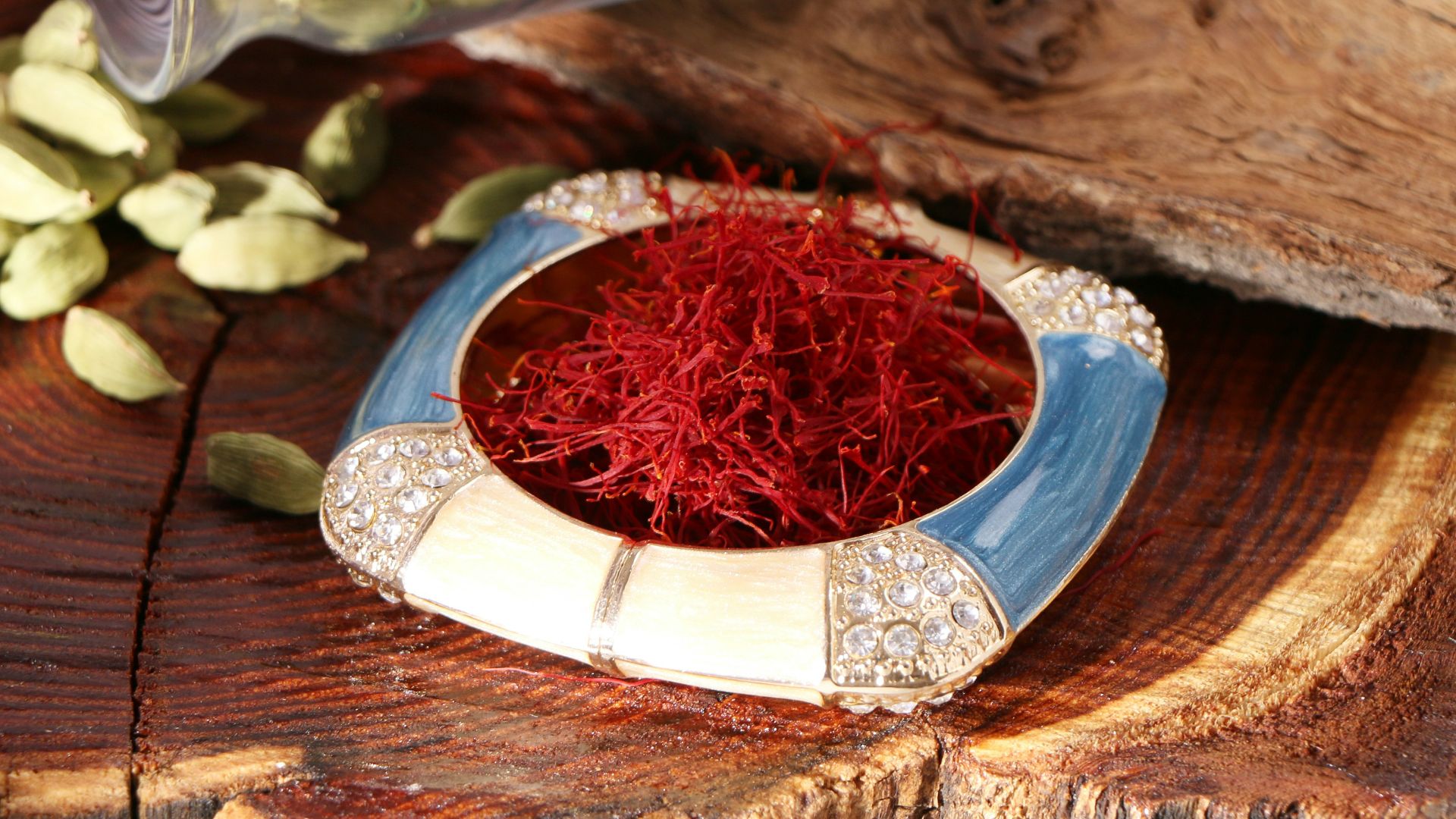
Saffron is the stigma of a purple crocus, and every flower carries exactly three of them. They come out by hand in the hours after the bloom opens, because sun and heat start degrading the threads almost immediately. Britannica puts a pound of saffron at 75,000 blossoms, which works out to about 165 flowers for a single gram. Hold a gram in your palm and you're holding a bed of flowers that took somebody most of a morning to clear.
The price follows from that. There is no aging step adding years to the cost and no cartel sitting on supply. What makes saffron expensive is the number of human hours between a field in October and a sealed tin, and the stubborn fact that no one has found a way to cut them down.
Why It Costs What It Costs
The plant works against you before the harvest even starts. Crocus sativus is sterile and sets no seed, so every field is cloned from corms that get lifted and divided by hand every few years. Nobody breeds a better strain in the usual way, because there is nothing to cross. What sits in the ground today is close to what grew in Persia three thousand years ago, with all the original inefficiency intact.
Flowering lasts a couple of weeks in late autumn, and inside that window the work compresses into a few hours each morning. Pickers take the blooms closed or barely opened, then sit with trays and pull three red threads out of each one. Britannica describes the stigmas spread out and dried over charcoal fires, which is still roughly the method across most producing regions.
Nothing has replaced the fingers. The thread has to separate from the pale stamen beside it without tearing, a job of about two seconds that nobody has automated at commercial scale. Labor is the bulk of the cost, and it refuses to shrink. A picker working a strong morning gets through a few thousand flowers, which dries down to something you could lose in a thimble.
Where It Actually Comes From
One country grows nearly all of it. A study for the UN Industrial Development Organization put more than 96 percent of global saffron production in Iran, while Iranian saffron accounted for only about 70 percent of the international trade. Re-export explains most of that gap. Threads leave Iran in sacks and get branded somewhere else, so the trade figures credit the sale to whichever country did the packing.
Spain is the clearest illustration. The same study found Spain produced 2.3 tons in 2010 while exporting around $50 million worth, an arrangement that only works if most of what leaves the country arrived there first. Over 95 percent of Spanish saffron exports go out in small retail packages, against the bulk sacks coming from Iran. Threads land by the kilo and leave in two-gram tins under a Spanish brand. The margin lives in the packaging.
All of which makes a label a softer claim than it appears. A tin marked in Spain can hold threads grown in Khorasan without anybody breaking a rule. Small growers elsewhere have been working the top of the market instead, selling provenance along with the spice. The University of Vermont's saffron program, which has spent years proving the crop survives New England winters, puts retail saffron around $5,000 a pound.
What's Actually In The Jar
Money like that attracts fraud, and the fraud is common enough to have generated its own research literature.
A 2022 study cites a survey of saffron sold in India where barely half was genuine, with the rest split between poor grade and outright adulterated. Of 80 market samples the authors tested themselves, 48 showed signs of tampering, and rates swung from under 1.5 percent in some cities to 40 percent in others.
What goes into the packet instead is cruder than you would guess. The same paper catalogs dyed corn silk and plain paper strips cut thin and colored, moving mostly through tourist markets and unregulated retail. Stigmas pulled from unrelated flowers get dyed and bundled in as well. Dyed stamens from the saffron flower itself are the common filler, since they arrive free with every harvest and read as close enough through cellophane.
Grading exists to deal with this. ISO 3632 is the international standard that sorts saffron into three categories by coloring power, which is measured through its crocin content, and the standard tolerates up to one percent foreign material in third-class product. Even the legitimate bottom end allows a little of something else in the tin. Buyers who care read for Category I and buy whole threads, because powder hides every defect the standard was written to catch.
KEEP ON READING
The Spice More Valuable Than Gold By Weight
Why Do Brain Freezes Happen?