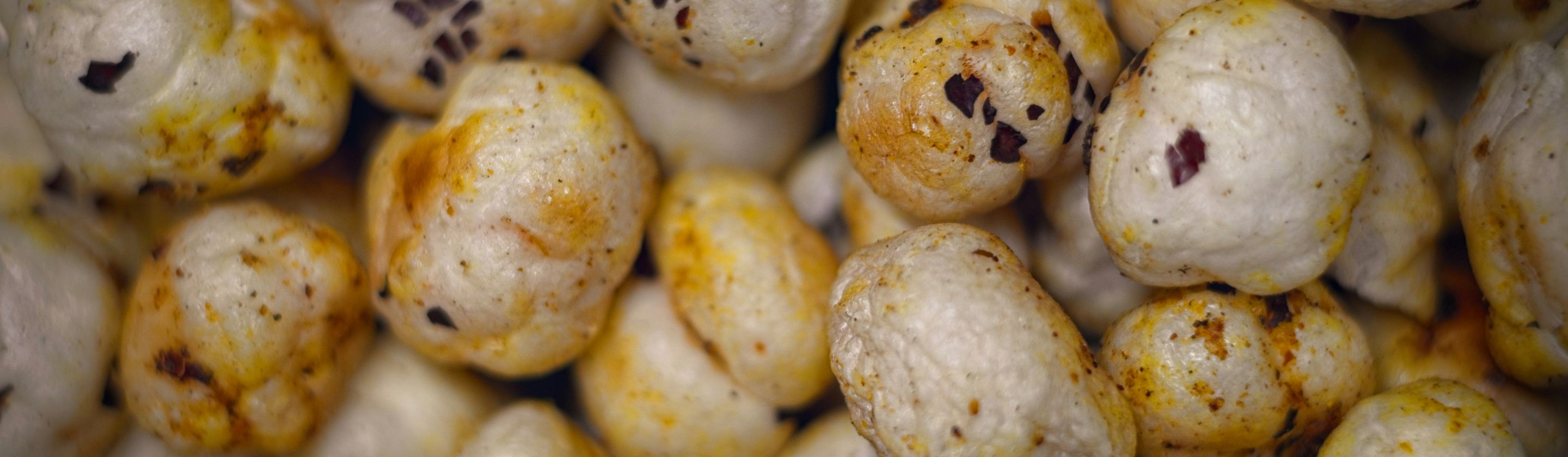
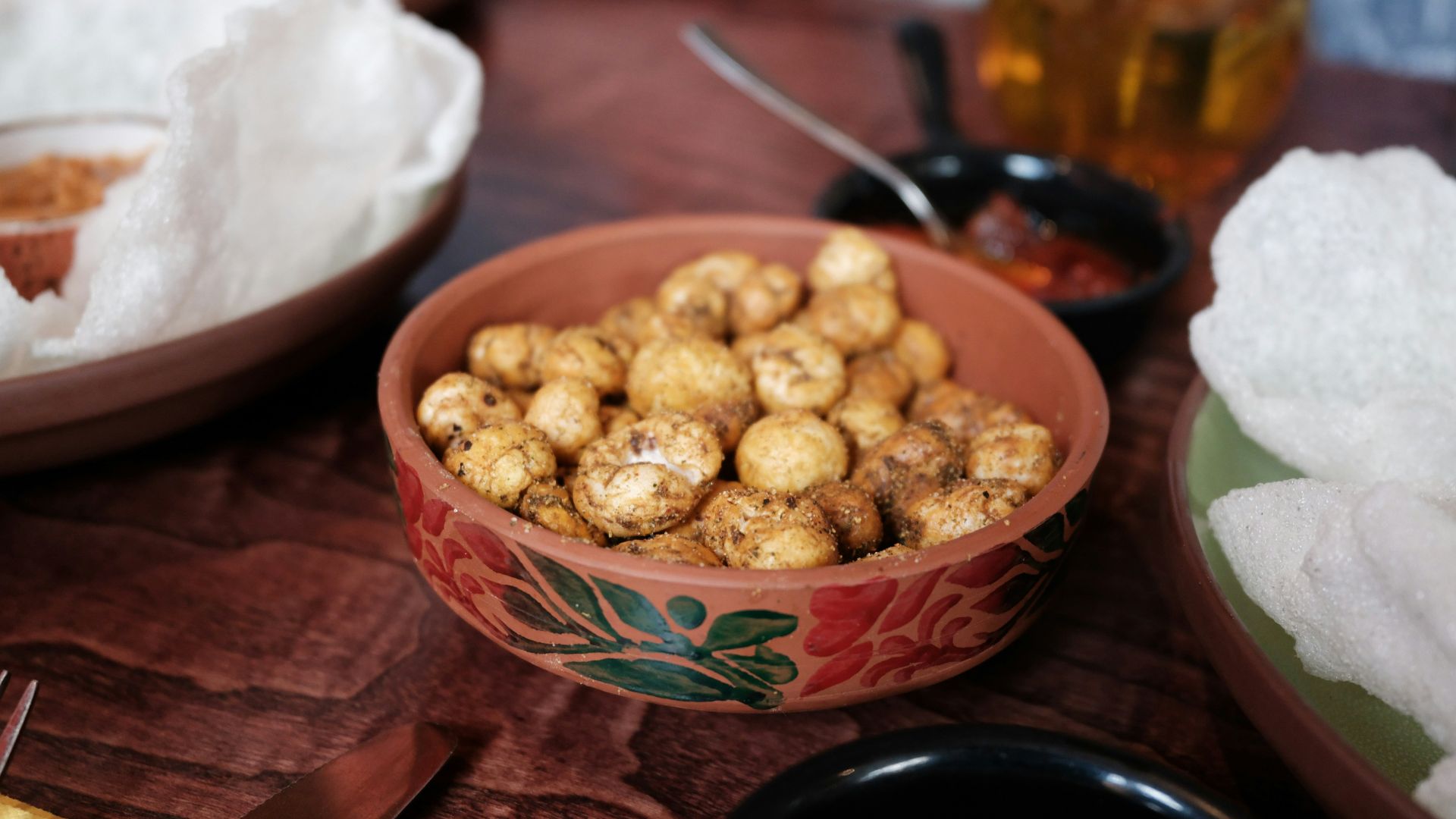
Makhana turns up in trail mix and in bowls at cocktail hour, puffed white and light enough to blow off the counter if someone opens a window. The seed behind it is nothing like that. It's a hard little sphere, dark and dense, hauled up out of the mud at the bottom of a pond.
Getting from the one to the other takes two trips through a scorching pan and a well-aimed hit with a wooden hammer. Nearly all of it happens by hand, in courtyards and village workshops across northern India, and the sequence resists being hurried.
The Seeds Come Up From Pond Mud
Fox nut grows in shallow water, and the plant drops its seeds when the fruit splits open. They sink into the muck, so harvesters wade in during the late monsoon months and feel around for them with hands and feet. Where the water runs deep, they dive for it.
What comes up gets rinsed and spread on mats in the sun. Fresh seed is heavy with water, and a few hours of drying pulls out enough of it for the roasting to do what it's supposed to do. Bihar handles the bulk of this, about three-quarters of what India grows, and the ponds of the Mithila region are the name you'll find on a premium bag. A single pond supports a season's work for a family, and the whole operation tends to stay within one.
Then comes sorting, which looks fussier than it is. The seeds go through a stack of iron sieves, each with a slightly tighter mesh than the one above it, until everything in a given pile is roughly the same size. Uniform seeds take heat at the same rate, so they'll pop together. A mixed batch gives you some that scorch and some that never open at all.
The seeds themselves are small, most of them under a centimeter and a half, so the sieving is done by feel and sound more than by eye.
The Hammer Has to Land in Time
The first roast goes into an iron pan, or an earthen one set over a wood fire, with someone stirring constantly with bamboo sticks. The pan runs brutally hot, in the range of 250 to 320 degrees Celsius. Nothing pops at this stage. The pass is about driving the moisture inward, toward the kernel at the center.
The seeds then sit at room temperature for two or three days. Water inside them settles into a more even distribution during that wait, and nobody has found a way around it. Rush the rest and the second roast gives you a pan of broken shells. Two days of doing nothing is built into a process that otherwise runs on timing measured in seconds.
The second roast is the quick one. A worker lifts the seeds out while they're still searing, sets one on a wooden block, and brings down a flat wooden mallet called a thaapi. The shell splits, the kernel bursts out white and many times its former size, and all of that has to land within a few seconds of the pan.
Hesitate and the puff comes out small and tough. Hands get burned doing this, and the people who are good at it have usually been at it for years. Roughly 40 percent of the starting weight survives as edible puffs, and the leftover shell gets burned as fuel while the bran goes into poultry feed.
Machines Can Do Most of It Now
A popping machine developed at a government engineering institute in Ludhiana arrived in Darbhanga in December 2013. It roasts inside a closed insulated barrel and tips the hot seeds into a casing that cracks them, so no one's fingers go anywhere near the heat.
What used to take two or three days by hand comes out in about twenty hours, and the puffs it produces tend to fetch a better price per kilo than the hand-popped kind. For a processor who can cover the upfront cost, it pays for itself inside a season or two. The research center in Darbhanga has licensed a washer, a grader, and a roaster alongside it.
Uptake has been slow, though, and most makhana still comes out of household and village-scale operations using pans and mallets. Part of that is the price of the equipment, and part of it is that the hand method, for all its burns and waiting, produces something people are already willing to pay for.
Demand keeps climbing, with India shipping thousands of tons abroad every year, so there's room for both the machines and the mallets for a while yet.