A block of it looks less like food and more like a chunk of driftwood somebody forgot in a shed for a decade. Tap it against a table and it clinks, almost metallic, nothing like the soft thud a piece of jerky or dried fruit would make. That block is katsuobushi, smoked and fermented bonito from Japan, and Guinness World Records has recognized it as the hardest food on the planet.
Getting a fish to that point takes months of work and a fair amount of mold, which sounds unappetizing until you realize the whole dashi stock underneath Japanese cooking depends on it. The process moves through smoking, drying, and repeated fermentation, and each stage strips away more water until what's left barely resembles fish at all.
Turning A Fish Into Something Harder Than Wood
Production starts with fresh skipjack tuna, filleted into manageable pieces and simmered gently rather than boiled hard, which keeps the flesh from falling apart before the real work begins. Workers pick out every bone by hand at this stage, since a stray one later would ruin a blade during shaving. Once deboned, the fillets go into wooden-lidded baskets over smoldering hardwood, usually oak or cherry, for the first real transformation.
Smoking here does not mean a quick session over a grill. The fillets get smoked for roughly an hour at a time, cooled, then smoked again, sometimes dozens of times across several weeks. Each round pulls more moisture out and drives smoke deeper into the flesh, which is what eventually gives the fish its long shelf life.
By the end of that stretch, moisture content has dropped to somewhere around 28 percent, and the block already feels closer to wood than seafood. This version, called arabushi, is dry and smoky enough for everyday cooking, and it accounts for most of the katsuobushi sold outside Japan. Reaching genuine hardest-food-on-earth territory, though, requires an entirely separate stage.
The Mold That Makes It Hardest
To produce the premium grade known as karebushi, workers spray the smoked blocks with a solution containing Aspergillus glaucus, a mold more commonly associated with sake and miso production. The blocks go into a humidity-controlled room for about two weeks, during which the mold's threads work their way into the fish and pull out moisture the smoking never touched.
Afterward, the moldy blocks come out into direct sunlight for a couple of days, then get brushed clean and inoculated again. That cycle, mold growth followed by sun-drying followed by another round of mold, repeats anywhere from three to six times, stretching the whole process out to roughly six months. Some of the highest grades, called honkarebushi, get aged well beyond that, occasionally past two years.
Each fermentation cycle breaks proteins down into free amino acids, which is the actual source of katsuobushi's intense umami flavor rather than any seasoning added afterward. Moisture content eventually falls below 15 percent, and the fish loses more than 80 percent of its original weight along the way. What started as a soft fillet ends up dense enough that people commonly describe its hardness as sitting around 7 to 8 on the Mohs scale, in the same range as some minerals.
Shaving Down A Block That Clinks Like A Rock
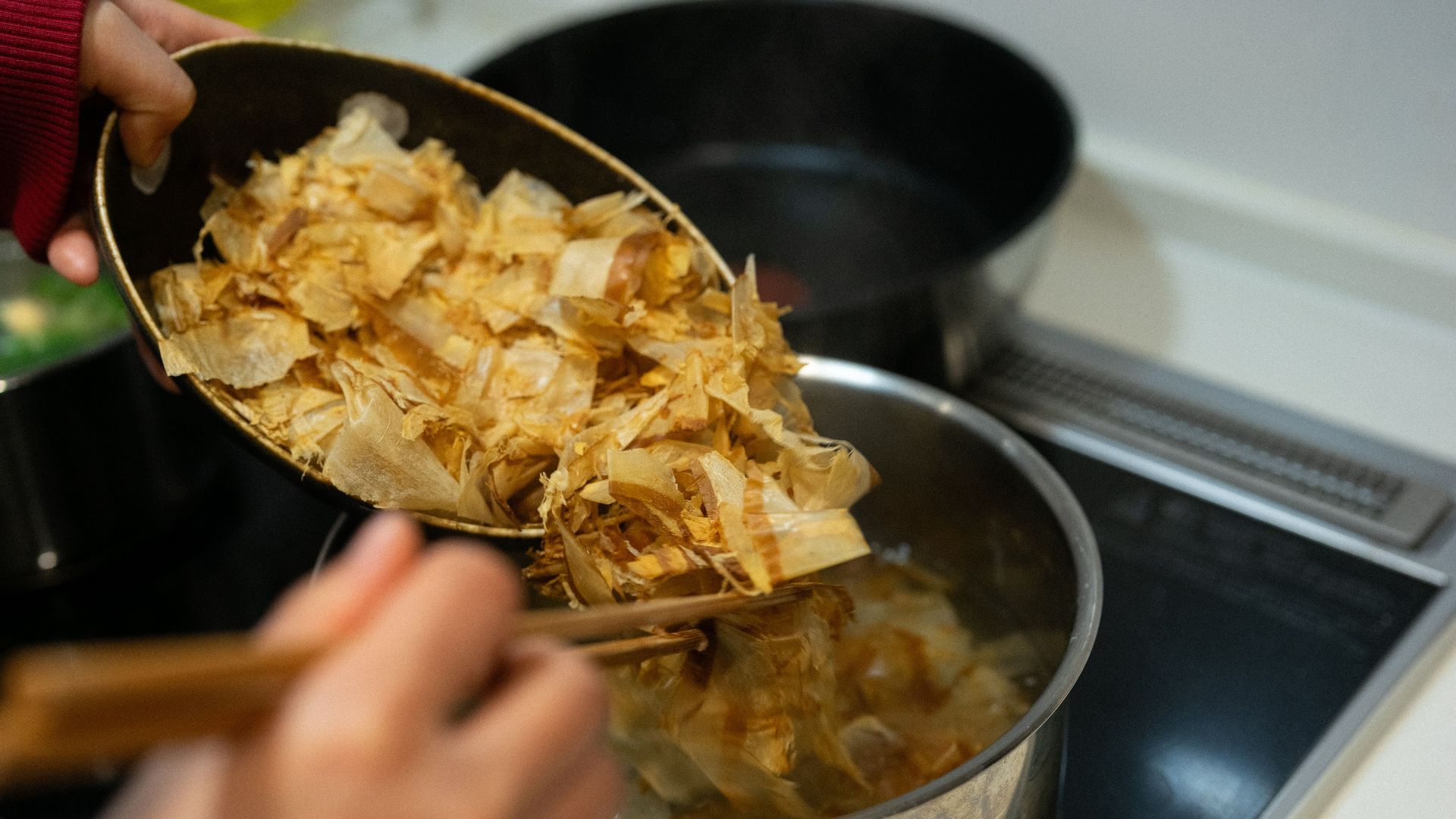
Once a block reaches that stage, eating it directly is not really an option, since biting into it would risk a chipped tooth rather than a bite of food. Instead, cooks use a tool called a kezuriki, a wooden box fitted with a sharp plane blade, dragging the block across it to produce paper-thin shavings. Good shavings run somewhere between 0.03 and 0.07 millimeters thick, thin enough to dissolve almost instantly in hot water.
Those shavings, tossed into simmering water along with kombu seaweed, become dashi, the stock underneath miso soup, noodle broths, and countless simmered dishes across Japanese cooking. The flakes also show up on top of okonomiyaki and takoyaki, where the rising heat makes them curl and shift in a way that looks almost alive, which is part of why they get served that way rather than mixed in.
None of this happens quickly, and very few producers still bother with the full six-month, mold-heavy version anymore. The ones who do treat it less like a food product and more like a craft passed down through a small number of family workshops, mostly along Japan's coast, where a block of dried tuna somehow ends up harder than the table it gets tapped against.