Sun-dried sea salt from Korea's west coast gets packed into a length of bamboo with both ends plugged by yellow mountain clay. The tube stands upright in a cast-iron kiln over a pine fire until the bamboo burns away to ash. Makers count five ingredients, and only one of them is edible. The other four are bamboo, clay, pine and iron. A column of grey salt survives the burn, and it gets crushed and packed into fresh bamboo for another round.
The nine-roast version is newer than the marketing suggests. Bamboo salt was fired two or three times for centuries as a Korean medicine, and the nine-firing method was worked out in the twentieth century. Salt made that way now sells for around a hundred dollars for a small jar, so the extra firings had better be doing something.
What Each Material Is Doing
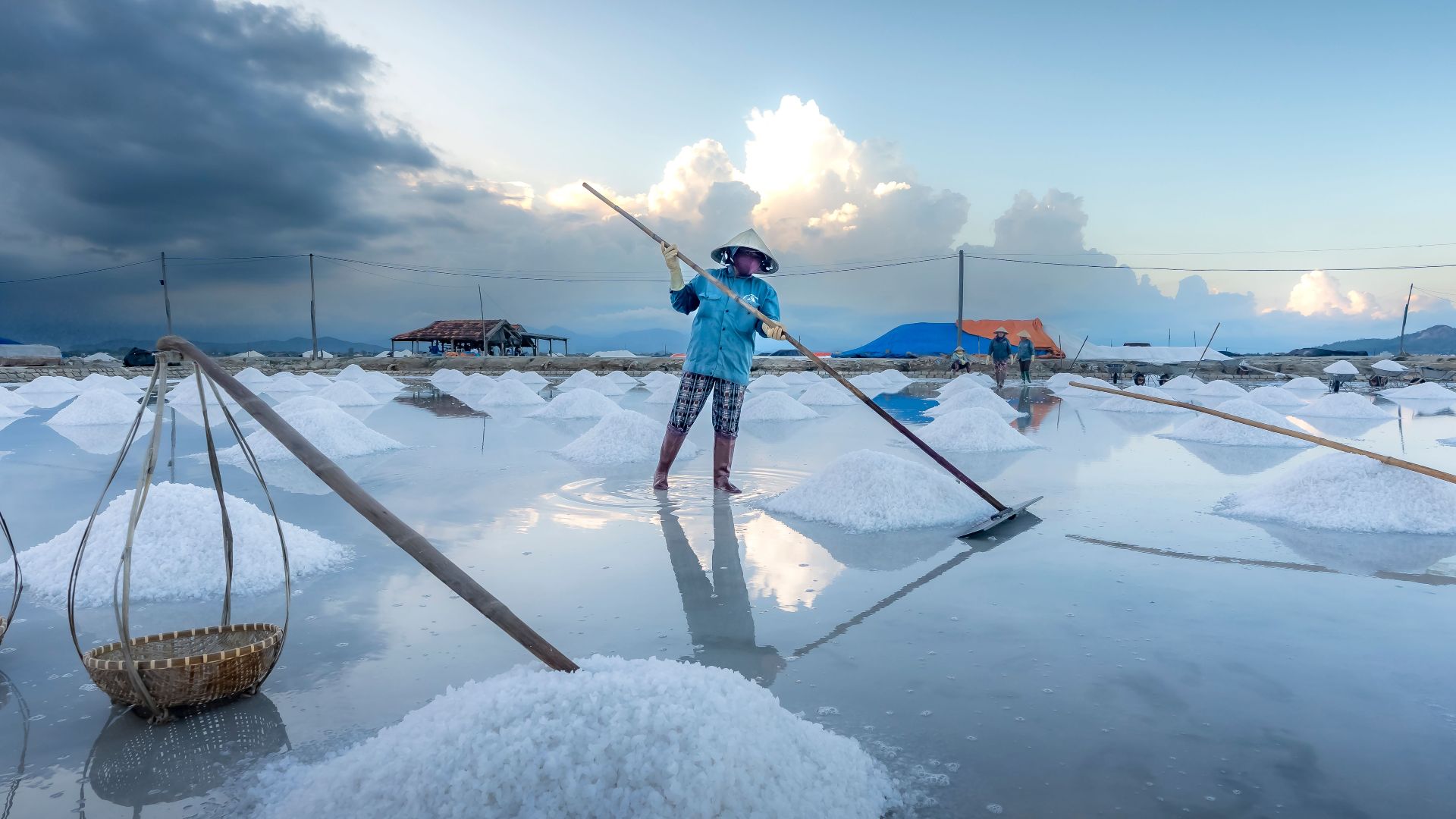
Makers specify stalks grown three years or so, thick-walled enough to hold a packed charge of salt without splitting as the water drives off. Packing is done by hand, one tube at a time. The salt is solar salt raked from the tidal flats of the west coast instead of mined rock or a refinery, so it arrives already carrying magnesium and traces of the mud it came from.
The yellow clay capping both ends seals the tube and contributes its own minerals to whatever is happening inside, so makers are particular about where theirs is dug. Pine is the fuel for a similar reason. Resinous softwood burns hot and fast, and the kilns are built to be fed continuously rather than banked down overnight.
Each of the first eight firings runs roughly twelve to fourteen hours at something over 800°C. That figure is doing precise work, because sodium chloride melts at 801°C. The salt in those early rounds sits right at the edge of its own melting point, hot enough to drive off water and burn away organic matter while holding its shape as a solid. Between rounds it emerges as a brittle pillar that has to be broken down before it can be repacked, and a little is lost each time.
The Ninth Firing
The last round crosses that edge deliberately, in a purpose-built furnace running past 1,000°C. The salt stops being a column and becomes a liquid, and it gets tapped and poured into a mold instead of lifted out. Footage of the stage looks more like a small foundry pour than like cooking.
Cooling takes days. A blackened, rock-like slab comes out of the mold and gets milled down. The best of it carries a deep violet cast that Korean sellers grade as purple bamboo salt. Older accounts describe the fired salt as carrying all five of the cardinal colors of Korean tradition. The color doubles as proof of temperature, since it appears only when the final firing has run hot enough. Pushing the heat that far also burns off a good deal more of the batch.
By the ninth firing the preceding eight rounds represent weeks of fuel and labor already spent, and a furnace that fails to reach temperature spoils the lot rather than merely underperforming. Start to finish, a single batch occupies a kiln and a crew for the better part of a month. The people trusted with the ninth firing have usually been doing it for decades.
What The Firing Actually Changes
Laboratory comparison puts nine-times-roasted bamboo salt at a pH of 11.04 against 9.13 for ordinary solar salt and 6.29 for refined table salt. The same work finds more potassium and iron than either. The difference is chemical and not cosmetic, and it is why the salt turns up in Korean toothpaste and soap as much as in cooking.
Repeated baking also changes the salt's sulfur content, which helps explain its unusual smell. Tests have found sulfur dioxide in purple bamboo salt but not in the original solar salt, with levels increasing the longer it's heated. This contributes to the distinctive odor that some people compare to eggs. Korean tradition also credits the bamboo with adding a faint sweetness called gamrojung, a quality praised in older texts rather than the salt's mineral content.
The marketing claims are harder to verify, with producers advertising dozens of minerals and a long list of health benefits. Many of these claims trace back to herbalist Kim Il-hoon, whose son's 1986 book sold nearly a million copies. His family founded the first bamboo salt company the following year. However, most published research has involved cells or animals, leaving little evidence that the claimed benefits extend to humans. The production process is interesting enough without the medical promises.